
AFCON 2025 Group Stage, Explained
Low blocks, wide rotations and the margins shaping the tournament


AFCON has a way of compressing geography. Stadiums fill with people who may never meet again, yet recognise themselves in each other almost instantly. The competition does not need framing devices or borrowed symbolism. Its weight comes from repetition: the patterns, the habits, the ideas that surface every two years and quietly evolve.
Across the group stage, familiar themes reappeared alongside new wrinkles. Some teams doubled down on structure, others leaned into chaos. There were low blocks that held, presses that fractured, wide rotations that clicked and others that stalled. What follows is a tactical snapshot of those opening weeks, not as a ranking of teams, but as a study of how different ideas tried to solve similar problems.
Morocco and the Problem of the Low Block
Comoros deployed a strict mid to low block, with a back five supported by a narrow four-man midfield. The objective was simple: deny access to central areas in and around the box. Given the disparity in individual quality, this approach made sense. Protect the most valuable spaces, compress the pitch, and force Morocco into low-percentage actions.
Morocco’s in-possession play, however, struggled to impose itself. As is common with many North African sides at both club and international level, half-spaces are central to their attacking identity. Walid Regragui attempted to stretch Comoros horizontally through counter-movements in wide areas. Saibari and Brahim Diaz frequently vacated the flanks to operate as false tens, while full-backs Mazraoui and Salah-Eddine advanced to exploit the space left behind.
The issue was cohesion. Rotations between the full-back, wide attacker and central midfielder often lacked timing and clarity. As a result, Morocco regularly found themselves without width or depth in key attacking sequences, allowing Comoros to remain compact and organised.
When a team relies heavily on wide combinations, access into the box becomes non-negotiable. Whether through crosses or cutbacks, the ball must reach viable shooting zones. Against Comoros’ structure, Morocco struggled to find those routes. They attempted 29 crosses and completed only five, a reflection not just of execution, but of limited penetration.
This led to a further issue. In games where space is scarce and defenders are content to protect the box at all costs, profiles matter. Anticipation, movement in tight spaces and physical presence become decisive. Soufiane Rahimi, deployed as the number nine, offered little in this context. He thrives with space to attack, not in crowded penalty areas. A striker like El Kaabi or En Nesyri would have been better suited, and it was a scenario Regragui could reasonably have anticipated.
Egypt and Wide Associations Done Properly
Watch enough North African football and certain patterns become familiar. Egypt leaned into those patterns, particularly in the half-spaces, but executed them with greater fluency than Morocco.
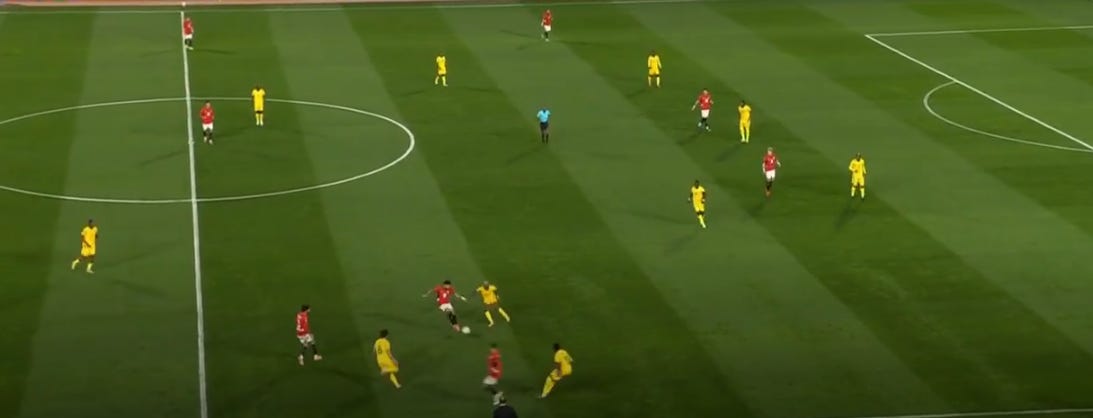
Their wide rotations were better timed and better coordinated. Players understood when to isolate, when to support, and when to vacate zones for others to attack. The personnel varied, but the shared understanding remained consistent.
That cohesion did not appear by accident. Long-term continuity matters, and so does chemistry beyond the pitch. While analysis often focuses on structure and spacing, coaches spend just as much time building relationships. Familiarity off the pitch often translates into sharper recognition on it.
Tactical analysis is not about shapes in isolation. It is about identifying recurring patterns, understanding what enables them, and judging their effectiveness relative to the opponent. Egypt’s wide combinations were a recurring feature, enabled by years of shared experience and reinforced by collective trust.
Nigeria and the Return of the Strike Pair
The use of a strike partnership has become increasingly rare. Modern systems prioritise midfield control, often at the expense of numbers up front. Eric Chelle resisted that trend.
Despite having considerable midfield depth, Chelle opted to start Akor Adams and Victor Osimhen together, leaving players like Akinsanmiro, Onyedika, Dele-Bashiru and Onyeka on the bench. Squad quality allows flexibility, and Nigeria leaned into it.
The system functioned in unconventional ways. Against Tanzania, Chukwueze operated almost as a hybrid right midfielder, drifting between the flank, the half-space and pockets between the lines. His movement created dilemmas, particularly when Osayi-Samuel advanced high on the right. On the opposite side, Iwobi’s instincts as a central player meant Sanusi provided the primary width.
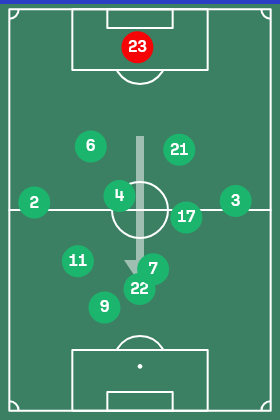
Against stronger opposition, adjustments were required. Chelle introduced Onyeka against Tunisia, adding defensive stability but sacrificing an option between the lines. Osayi-Samuel was given greater license to push on, shifting the balance of the structure.
Nigeria exploited half-spaces effectively when Tunisia’s wing-backs jumped onto the full-backs. Early deliveries became a key weapon, playing directly into Osimhen’s strengths. His movement and physical presence generated multiple early chances, including a disallowed goal following a turnover and quick transition.
At the hour mark, Nigeria deliberately baited Tunisia’s midfield press. Iwobi dropped deep, pulling a marker, while confusion on Tunisia’s left opened space centrally for Lookman to receive and attack the last line.
In a tournament context, marginal gains matter. Nigeria’s effectiveness from set pieces and long throws underlined that point. When systems are rare, preparation gaps appear, and Nigeria exploited them.
Tanzania and Uganda: Fine Margins and Tactical Risk
In their first AFCON meeting, Tanzania struggled in build-up almost immediately. By committing players high, they failed to occupy deeper spaces that opened under pressure. Orchestrators could not cope, and long balls became the default.
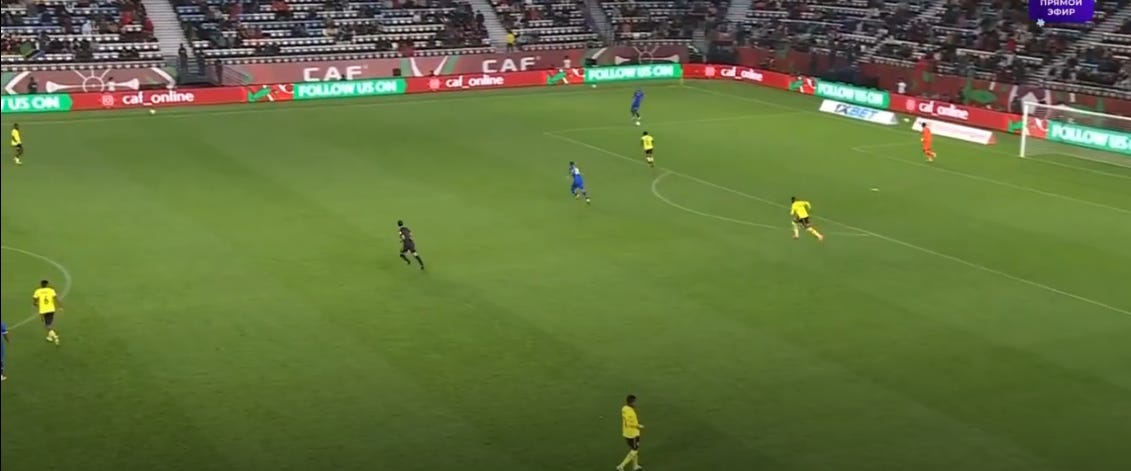
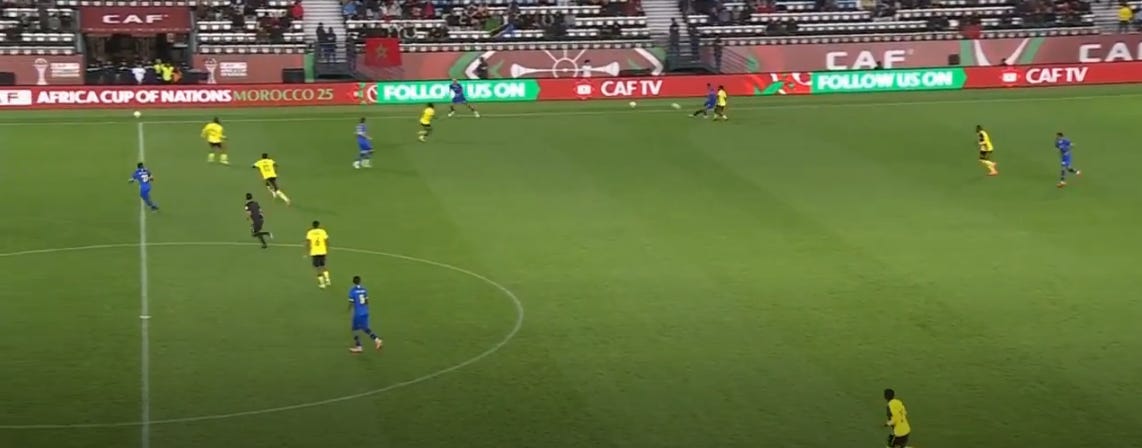
Uganda were more composed. Shorter distances between players and greater pressure tolerance allowed them to circulate possession more effectively.
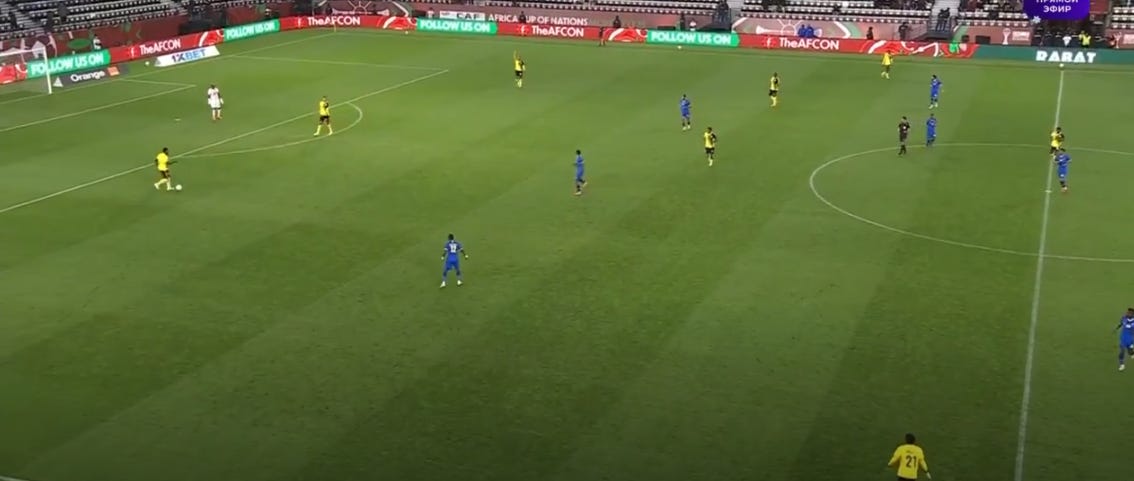
Semakula’s inclusion in the first line of build-up forced Tanzania into a choice: abandon their zonal press or concede territory. Uganda’s structure also enabled Allan Okello to influence the game early. Positioned asymmetrically on the right, he was tasked with holding width, creating through passes, and attacking central areas when cutting inside. He delivered on all counts.
The match became increasingly end to end. Both teams transitioned quickly, creating a tempo that demanded constant physical output. Abdul Aziz Kayondo stood out in this context, repeatedly overlapping from left-back and delivering dangerous crosses.
After Simon Msuva’s penalty, Tanzania altered shape to a 3-5-2. The intention was greater defensive solidity, but the risks were clear. The system had little precedent at this level, and familiarity was limited. Uganda equalised through Uche Ikpeazu, and the chaotic game state that followed was unforgiving.
Against Tunisia, the same structure showed improvement. Defensive shuffling was more coordinated, central spaces were better protected, and progression through the middle was restricted.
Cameroon, Ivory Coast and the Value of Out-of-Possession Clarity
Cameroon’s approach without the ball was decisive. While Ivory Coast preserved an extra man in the back line and assigned hybrid roles in midfield, Cameroon committed to a five-man defensive structure. Wing-backs pressed aggressively, disrupting progression and denying central access.
Ivory Coast’s pressing plan was theoretically sound, but impractical against Cameroon’s spacing. Switching markers across large distances proved unsustainable.
Nouhou Tolo’s role was key. Acting as an auxiliary centre-back, his movements allowed Cameroon to oscillate between a back four and back three during build-up, maintaining numerical advantages.
There were still questions about Cameroon’s in-possession play. Under pressure, they went long frequently, relying on aerial duels and second balls. While this may unsettle opponents unaccustomed to such football, it introduces variance and limits control.
Mali and Central Protection as a Tactical Choice
Mali approached Morocco with a clear objective: limit influence in central areas. They achieved this through a compact 4-4-2 mid-block and midfield-heavy personnel selection.
Coulibaly, Dieng, Sangare, Doumbia and Bissouma formed a dense central core, reducing unpredictability and forcing Morocco wide. Pressure was applied not in build-up, but in the middle third, where distances were shortest and control most effective.
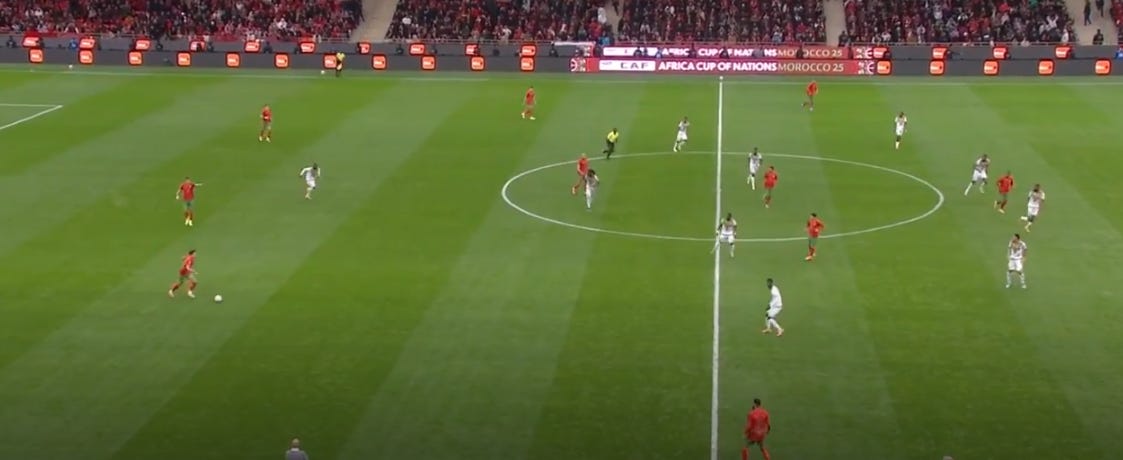
In the image above you can clearly see how Mali lined up in two compact banks of four preceded by a bank of two (Lassine Sinayoko is making his way back into position). The aim was clear, as seen here, there was little to no pressure applied on the Moroccan center backs throughout the game, instead there was immense pressure applied in the middle third. The key was distancing. As long as they were close they could control which spaces their opponent had access to.
In possession, the benefits were clear. Full-backs could advance knowing midfield cover existed, and ball retention improved through numerical superiority.
The result was a controlled draw that reflected the clarity of Mali’s plan.
Senegal and the Value of the Flying Full-Back
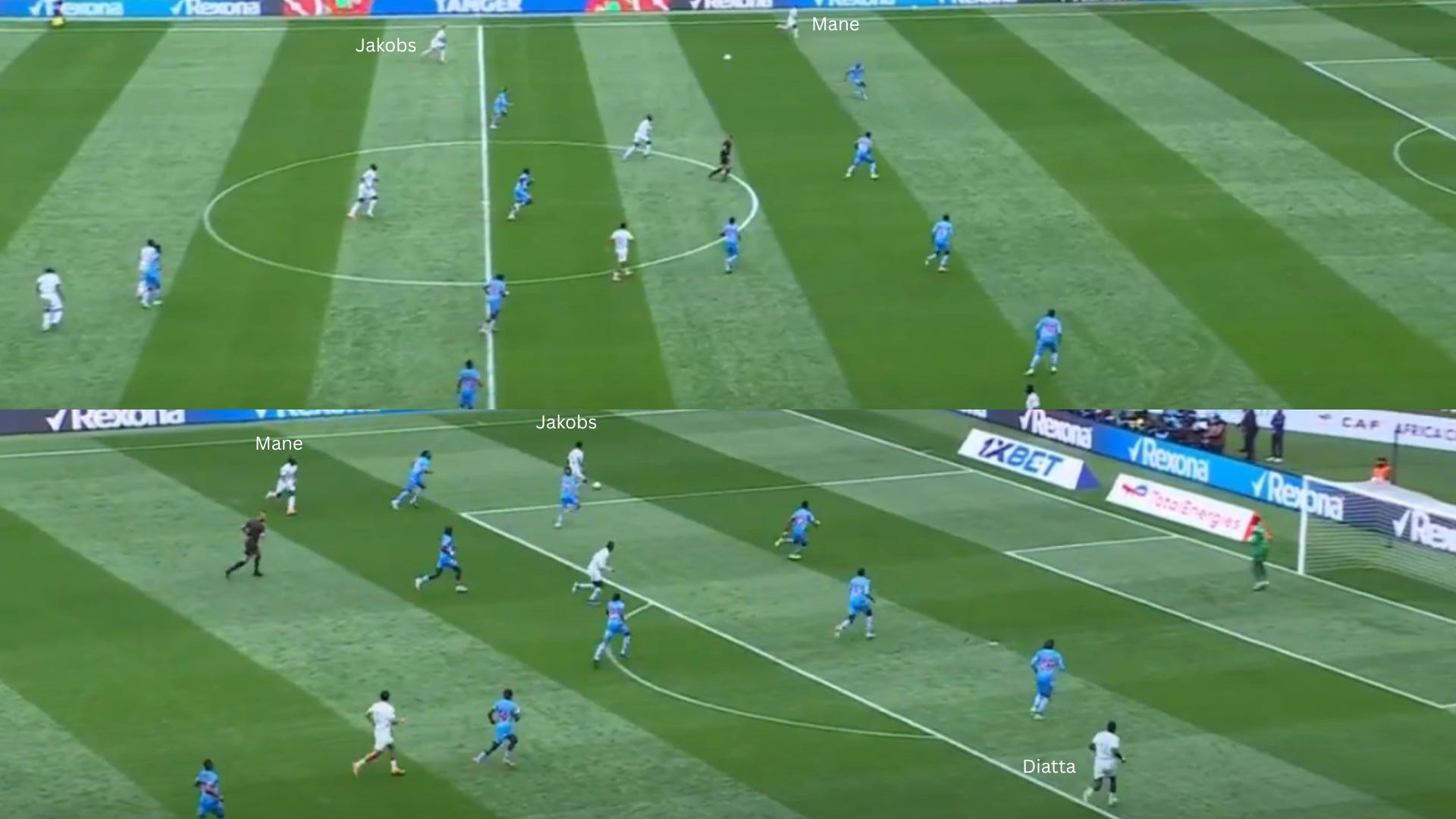
Senegal’s full-backs, Krepin Diatta and Ismail Jakobs, were among the most active in the group stage. Their crossing volume reflected a deliberate strategy: wingers inside, full-backs arriving dynamically.
Aliou Cisse’s profiling of wide roles has been reinforced under Pape Thiaw. The pattern is familiar, but variation in timing and delivery keeps it effective.
Jakobs’ off-ball run against Congo illustrated the principle. Attacking the blind side, arriving late, and creating danger without direct involvement in build-up.
The challenge lay elsewhere. Senegal’s attacking depth is heavily weighted towards wide players. Thiaw’s decision to deploy Illiman Ndiaye as a central creator behind Nico Jackson was pragmatic. Ndiaye’s movement, balance and combination play fit the role, even if output remains an area for growth.
South Africa and the Limits of Wide Reliance
South Africa’s creativity problem resurfaced against Egypt. With wingers on their natural sides, the intention was quick delivery. The trade-off was reduced one-on-one threat.
Egypt’s out-of-possession scheme amplified this. Mohamed Hany’s high starting position triggered coordinated shuffling movements behind him, maintaining pressure in the middle third while accepting ball-far freedom.
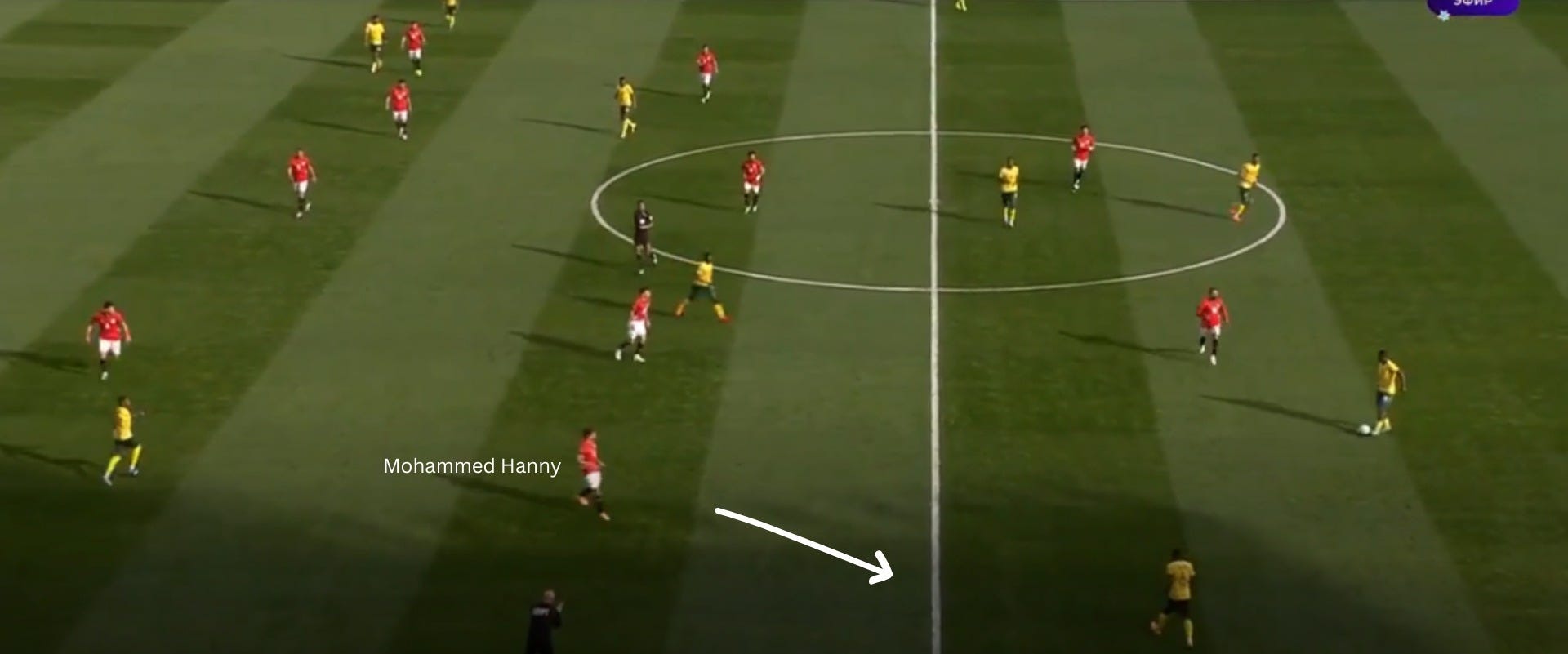
The approach was demanding, and occasionally disjointed. Hany’s confusion in certain moments exposed Egypt’s back line, but South Africa lacked the mechanisms to exploit it consistently.
Possession remained sterile. One shot, minimal final-third entries, no corners. The red card changed the match, but the first-half patterns were telling.
The group stage rarely tells the full story, but it leaves clues. Across AFCON 2025 so far, there has been no single dominant model, only trade-offs. Control versus risk. Structure versus spontaneity. Physicality versus fluency.
Established powers have largely imposed themselves, though seldom without resistance. Underdogs have shown that clarity of idea can still narrow gaps in quality. As the knockout rounds approach, margins will tighten and tolerance for experimentation will shrink. What remains is a tournament defined less by reputation and more by execution, where small tactical decisions increasingly decide everything.